
The Last Two Days of a House
An old house in Porto, two days before it came down, and an instruction nobody had ever given us: take whatever you think is worth saving.
The job arrived as a video.
Forty seconds, filmed on a phone: high ceilings, furniture stacked against a wall, the shapes of things under sheets. I took it for a warehouse. An urgent move, they said. Could we come this week.
It wasn't a warehouse. It was a house — one of those old ones with a presence, the kind that doesn't need anyone to tell you it has a history, because it's in the proportions of the rooms and the way the light comes in. You walk in and lower your voice slightly without deciding to.
The staircase was red. Wide, wooden, red, curving up through the middle of the house, and there were symbols carved into the walls — the kind I've now seen in enough houses like that one to recognise, and still don't properly understand. If you live in this city you already have a picture in your head. I'll leave it there.
The owners met us at the door and said something nobody has ever said to me in any house, in any job.
Take whatever you think is worth saving.
The house was going to be demolished.
Two days, two vans
Furniture, books, clothes, paintings, mirrors, ornaments. Barrels, corks, bottles. And crockery — an astonishing amount of old crockery, the quantity that only accumulates when nobody in several generations has thrown anything away.
There were statues. Indoors. That tells you the kind of house it was, and it's the only sentence I'll spend on the size of it.
The statues the family saved themselves. What they handed to us was everything after that.
I want to be accurate about what that felt like, because it wasn't romantic. It was arithmetic. Two days, two vans — we brought a second one and extra crew, because it was a big job and we could see that from the video — and a house full of things that any collector would have picked up carefully and turned over in their hands.
We were not going to get all of it out. That was clear by the first afternoon and it stayed clear.
I'm not going to tell you why the house was being sold. It isn't mine to tell. And you don't need it: people who don't care do not invite two strangers into their family home and ask them to save things. Nobody in that house was relieved. It was a large family and it was a hard decision and they made it the way people make hard decisions, which is slowly and then all at once.
Under the house there were two tunnels
Cellars, both of them. Cool the way only underground is cool when it's thirty degrees at the top of the steps. Walls of bottles, sealed and waxed, decades deep. Barrels.
We were down there a long time, and we were not down there alone. One after another, members of the family came down and walked us through it. What the gardens had looked like before. Which fruit came in when, and what the work was during each harvest. Making the jam. Making the liqueur. The parties — all of them, apparently — under one big pergola.
Nobody was hurrying us. I think they wanted somebody to have seen it.
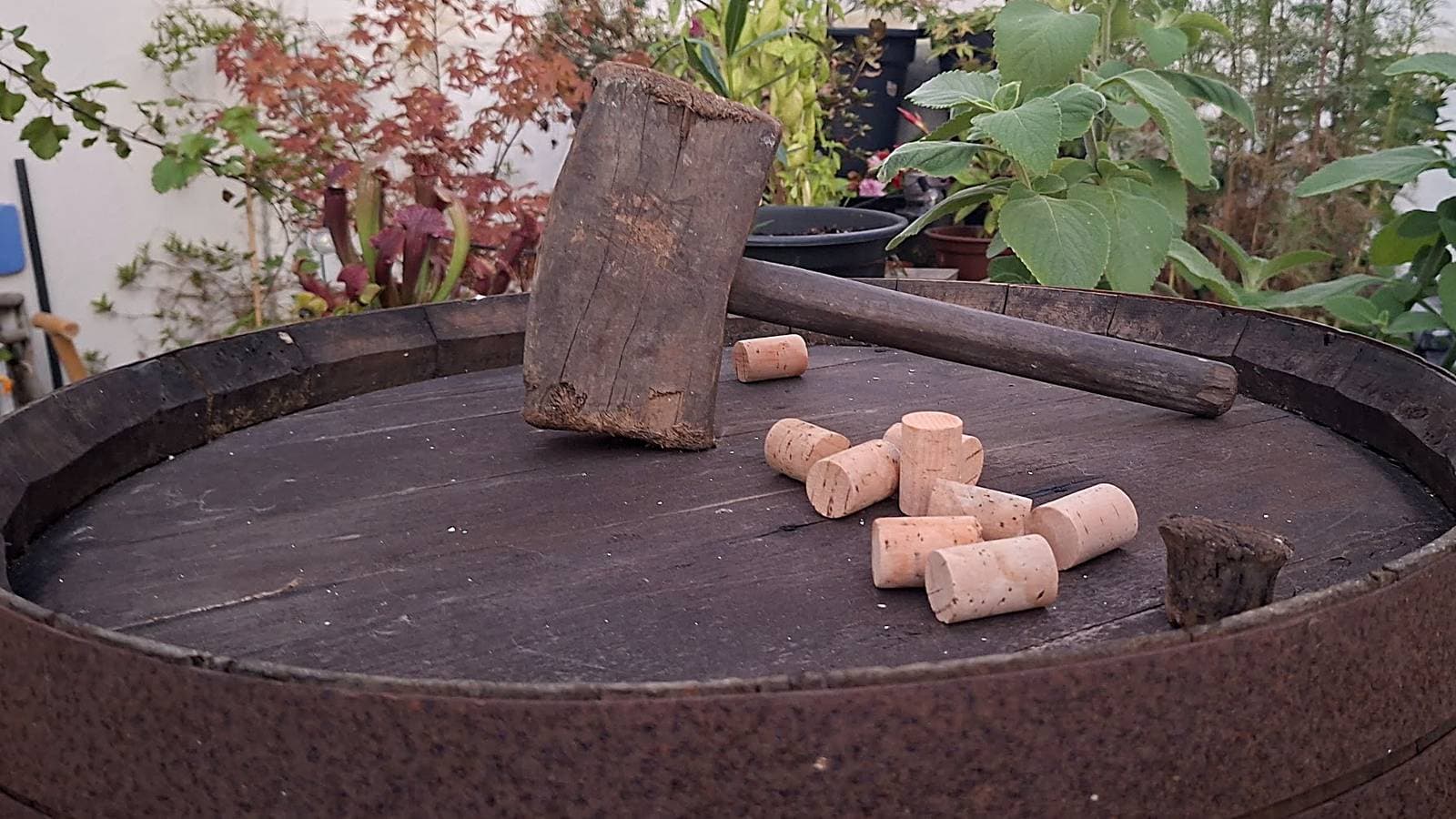
There was a wooden mallet propped against one of the barrels. The big kind, head the size of a loaf, handle worn pale where hands go. I had my hand on it when one of the men reached over and picked it up.
He was a big man, broad across the shoulders, the sort who fills a doorway without intending to. He turned the mallet over once, the way you check something you already know by heart, and told me he had been working with it since he was a boy.
Then he told me about the wine.
On estates like that one they used to make vinho proibido — the forbidden wine, made from American vine stock, whose sale has been banned in Portugal for decades and across the European Union since 1995, and which families carried on making at home anyway because it was theirs and because nobody was selling it to anyone.
Grown adults, underground, standing in the middle of their own childhood, on the week it was being emptied.
What we didn't carry
We got some of the barrels out. Most of what was down there stayed down there.
That's the part I keep going back to — not what we carried, but what we didn't.
For a day or two I let myself think that in a few hundred years somebody would dig beneath the ruins of whatever they put there instead, find a wall of sealed bottles in the dark, and wonder what on earth had happened here. I liked that idea a great deal. It made the whole thing survivable.
Then I remembered what goes underneath a building that size. Four floors of parking.
So the cellars go too. Nothing down there is waiting for anybody.
Which means the only part of that house with any future at all is the part that went out through the door on those two days.
That's the whole of it. Two days, two vans, and no third day.
What I took home
Some of the barrels are at my house. Some of the crockery. And the corks — a whole bag of them, brand new, never used. Nobody is going to be filling those bottles now, which makes a bag of unused corks close to the most pointless object in that cellar. I took them anyway.
And the mallet. I asked him whether I could take it.
He was delighted. Not polite — delighted, that somebody would look at a tool he'd had in his hands since he was a boy and see something worth keeping. It had never been a relic to him. It was the thing you reached for when something needed a good hit.
I move other people's things for a living. The whole shape of the job is that you pick something up carefully, you set it down where it belongs, and you leave. This is the first time I've kept anything — and what I kept was a hammer that somebody else's hands made smooth, and a bag of corks I am never going to find a use for.
I knew that when I picked them up. That wasn't what they were for.
What was still available to us
We couldn't save the house. Nobody could, and by the time we arrived that was no longer the question.
What a moving company can do is get things out of a building while it's still a building. That turns out to be the only part of any of this that was ever available to us — and on that particular week, it was worth doing properly.
We look after your things. But we also try to look after the moment you're going through.
Moving in Porto?
Tell us what you need moved — big or small, with kids or pets or one fragile thing. A free, no-pressure quote, from a team that treats your move as more than boxes.
Get a free quote on WhatsApp