The Last Thing We Hand You
A small plastic cat at the door — and why it only works because everything before it was true.
She called at night.
The job was small: a couple of pieces of furniture going out to a village a long way from Porto. She was brisk about it — dates, price, address, done. No small talk, and no reason for any. It was late, it was a short job, and there was nothing in it that needed to become a conversation.
That's a lot of what this work looks like, and it's fine. Not every move is somebody's whole life. Some are two chairs and a table.
So we drove out, carried the furniture in, put it where she wanted it, and she paid us. And then, on the way out, at the door, we gave her a keyring.
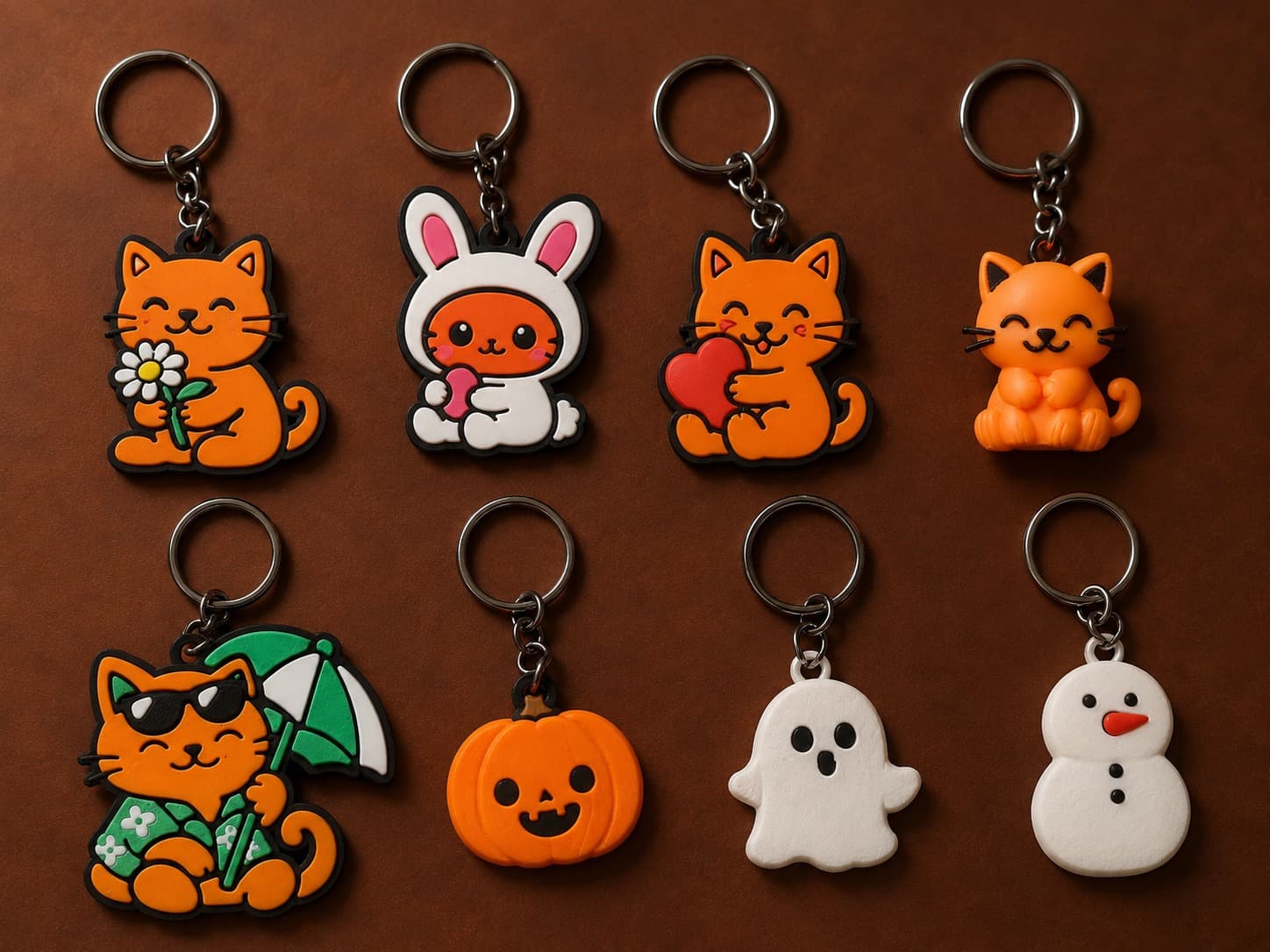
It's a small plastic cat. That's all it is.
Her face changed. I don't have a better way to say it than that. Something in her posture came down half an inch, and she laughed, and suddenly we were three people standing in a doorway in a village at the end of a long day, instead of a customer and two men with a van.
She has been recommending us ever since.
People photograph them
I could tell you that story and you'd have to take my word for it. So here's the part I can prove.
They photograph the keyring on their new keys and put it in a Google review. They put our sticker on a thermos and post it months later — "accompanying me everywhere." One went onto a mate flask that now lives in Belgium. One went onto a thermos at a motocross track. Four friends posed holding them like tickets. Somebody put our logo on a hoodie and posted a picture of it, which I still don't entirely understand.
None of that was asked for. We don't run a hashtag. There's no discount for tagging us.
And this is the part that took me longest to notice: the objects leave the house. A keyring stays with your keys, fine — but a sticker on a thermos goes to work, to the gym, to another country. It's a moving company being carried around by the person who moved. We are not there. The cat is.
The order matters, and it isn't reversible
Now the part I want to be careful about, because it's where this could go wrong.
Here's a review from a client we've moved twice:
"I've used this company for 2 transports and everything went smoothly and exactly as planned. The team is super helpful and friendly, and they always make the whole process stress-free. Also, they are genuinely great people with an awesome sense of humour. And I absolutely love their cat gadgets."
Read the order. It went smoothly. It went as planned. It was stress-free. And then, at the end, the cats.
That order is the whole thing, and it isn't reversible. The cat doesn't do the work. The cat marks that the work is done. If the sofa had arrived scratched, a small plastic animal wouldn't have softened that — it would have made it worse, because now you've been handed a toy instead of an apology.
So this isn't a story about how a nice gesture can carry a service. It's the opposite. The gesture only means anything sitting on top of a job that was already finished properly. Everything below it has to be true first: the van arriving when we said, the sofa arriving the way it left.
Why it works at all, I think
By the time we hand over the cat, we've been paid. The job is closed, and there is nothing left to sell. Whatever the object is, it can't be a tactic — the moment where a tactic would be useful has already passed. I think people register that instantly, without having to think about it, the way you register a tone of voice.
And then it does something to the day itself.
Up until that doorway, her afternoon had been a transaction: a thing she'd arranged, paid for, and could now stop thinking about. Thirty seconds later it was something that had happened to her — a small story, with characters in it, one of whom was a cat. Same furniture. Same village. Same price. A completely different memory.
That's it. Not the object. What the object does to how the day gets remembered.
The unglamorous part
We make them ourselves. We design them, print them on our own 3D printers, and assemble them at home, usually at night, usually badly. They are small pieces of plastic. This is not generosity — we enjoy it, which is roughly the opposite of a sacrifice.
I say that plainly because if the point were the gift, the answer would be to give a bigger one, and I'm fairly sure a bigger one would work worse. A large present at the end of a job puts a weight on people: now they owe you something. A small plastic cat doesn't ask for anything back. It's just the end of the day, marked.
There's a beach one for summer, an Easter one, a Halloween one, a Christmas one, and we rotate them through the year. Clients who move a second time ask which one we have now. That wasn't a strategy either. We just liked making them.
Where it came from
The cat existed before the van did.
The day we decided to start Don Michi, my partner sent me a set of drawings by chat: the character, the logo, even the t-shirts, all worked out in a single afternoon. That same day we went out, found a van, and bought it. The order sounds wrong said out loud — the mascot before the vehicle — but it turned out to be the right one. The van is how we do the work. The cat is what the work feels like.
Every keyring we hand over is that same drawing, in someone's hand, at the end of their moving day. And then, quite often, on a thermos in Belgium.
Moving in Porto?
Tell us what you need moved — big or small, with kids or pets or one fragile thing. A free, no-pressure quote, from a team that treats your move as more than boxes.
Get a free quote on WhatsApp