
Moving House in Porto with Pets: How to Keep Them Calm and Safe
For the four-legged members of the family — from a team that moved six cats across two continents.
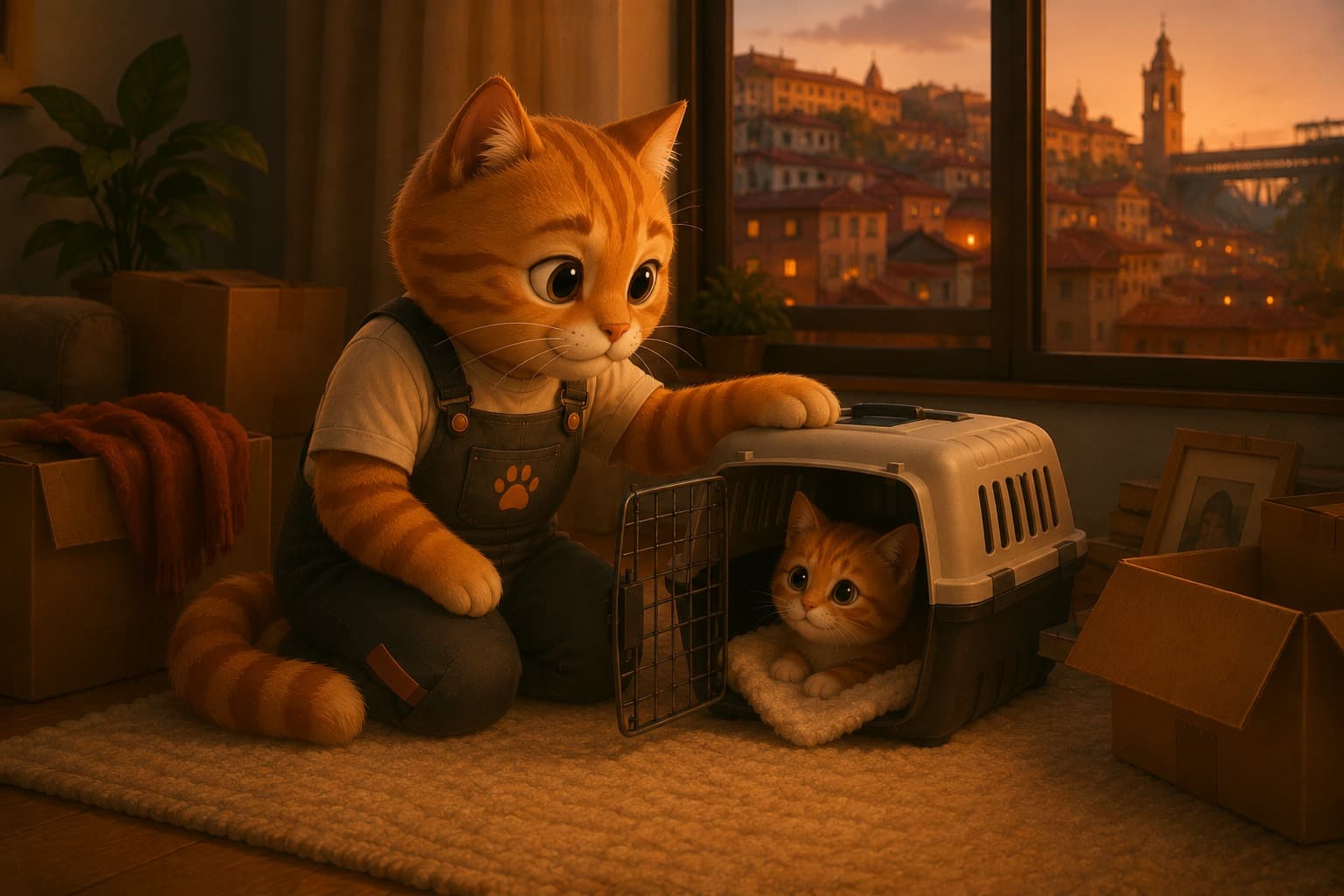
Moving to a new home is stressful enough. Doing it with a cat who hides at the first sight of a cardboard box, or a dog who paces the moment the furniture starts moving, is a different challenge entirely.
Most guides about pets in Portugal focus on how to bring an animal into the country: microchips, rabies vaccines, paperwork. That matters, but it's not what this guide is about. This is for people already living in Porto (or anywhere in Portugal) who are moving house and want the day to be as calm as possible for the four-legged members of the family.
We know this one well. We moved from Argentina to Brazil, and later from Brazil to Portugal — with six cats. Twice we packed up an entire home, a family, and half a dozen deeply unimpressed felines, and got everyone safely to the other side. Since then we've moved cats and dogs across Portugal and beyond, including a cat from Porto to Madrid. So when we say we understand moving with animals, it's not a slogan. It's experience.
Here's what actually helps.
Start weeks earlier than you think: the carrier
If there's one tip in this guide worth acting on today, it's this one — because it's the one that needs time, and the one almost everyone gets wrong.
Most people keep the carrier stored away in a cupboard and only bring it out on the day. From your cat's point of view, that box means one thing: something unpleasant is about to happen. Watch how they react to it and you'll see it — they don't experience it as transport, they experience it as an ambush. No wonder they run.
Instead, take the carrier out weeks before the move — the earlier the better — and simply leave it somewhere accessible, open, with a soft blanket or cushion inside. Let your cat sleep in it, hide in it, ignore it, come back to it. What you're doing is turning the carrier from an ambush into a den: a familiar, safe space that smells of them. On moving day, an animal that already loves its carrier travels in something that feels like home, not like a trap.
On the day itself, make sure the carrier still smells of them, and put something soft inside. Stress can cause accidents — that's fear, not bad behaviour — and while carriers are designed to drain to the sides, an animal shouldn't have to sit on a hard, wet surface. A blanket, a cushion, or an absorbent pad keeps them comfortable and dry.
Animals feel the change before the first box is packed
Pets are creatures of routine and territory. Long before moving day, they notice the boxes, the shift in the air, the disruption of their space. Cats especially can become anxious, hide, or stop eating; dogs may become clingy or restless.
The kindest thing you can do is keep their world as normal as possible for as long as possible. Feed them at the usual times, keep their bed and toys out until the last moment, and give them attention even when you're busy. A calm animal on the days before the move is a calmer animal on the day itself.
The safe room: the single most important thing on moving day
On moving day, the worst place for a pet is in the middle of the action — open doors, people carrying furniture, unfamiliar noise. A frightened animal's instinct is to get away and hide, and that's the last thing anyone wants in the middle of a move. The good news is that it's easy to prevent.
Give them one closed, quiet room to stay in while everything else happens. Put their bed, water, food, litter tray, the carrier and a favourite toy in there, close the door, and let everyone know it stays shut. Your pet has a calm base away from the noise, and there's no way for a scared animal to reach an open front door while boxes are being carried out to the van.
Make that room the last one to be packed and the first to be set up in the new home, and the disruption to your pet is kept to a minimum.
Keep a familiar scent in the new home
When you arrive at the new place, everything smells wrong to an animal — and smell is how they understand the world. Bring their unwashed bed, blanket and toys, and set them up first, before you unpack everything else. That familiar scent tells your pet "this is still your home, just in a new place," and helps them settle far faster.
The first days matter just as much as the day itself. A pet in a new home hasn't mapped its territory yet, and an animal that goes out before it knows where home is can struggle to find its way back. Keep them indoors, in one calm room at first, and let them explore the rest of the house gradually and at their own pace. Give it time. They'll tell you when they're ready.
The part most movers never think about: someone who travels with them
Here's where we do things differently, and it's the part we're most proud of.
For most moving companies, a pet is just one more thing to load. For us, an animal is never cargo. When we move a family with pets, someone travels with the animals in the van — talking to them, keeping them calm, making sure they feel safe the whole way. We've taken three dogs and two cats from Porto to Viseu that way, with one of us sitting beside the dogs so they wouldn't be alone, stopping several times along the route so everyone could rest.
It goes further than that. When we walk into a home with a cat or a dog, we don't reach out to pet them. We let them come to us, sniff us, take our measure in their own time — because approaching an animal in its own territory is intrusive, and they've already got enough going on that day. And we talk to them. The human voice is one of the best tools there is for calming an animal, and it costs nothing to use it.
These sound like small things. To anyone who loves their pet, they're everything. Knowing that your dog isn't alone and frightened in a moving vehicle — that there's a person right there, talking to them, stopping when they need to stop — is the difference between a traumatic day and a manageable one.
Practical tips for the journey itself
- Use a carrier your pet already knows and likes — familiar, never brand new.
- Line it with something soft that smells of home; add an absorbent pad if the trip is long.
- Don't feed a large meal right before travelling, to avoid car sickness; a little water is fine.
- Pack their essentials in one bag: food, bowls, medication, litter, a favourite toy, a familiar blanket.
- On long journeys, plan stops so everyone can rest.
- Keep the first days in the new home calm, indoors, and let them explore one room at a time.
Moving in Porto?
Tell us what you need moved — big or small, with kids or pets or one fragile thing. A free, no-pressure quote, from a team that treats your move as more than boxes.
Get a free quote on WhatsApp