
Arrumos
Two calls in the same week: take this perfectly good sofa to the ecoponto, and please be careful with these five boxes of ornaments. They are the same system, seen from two ends.
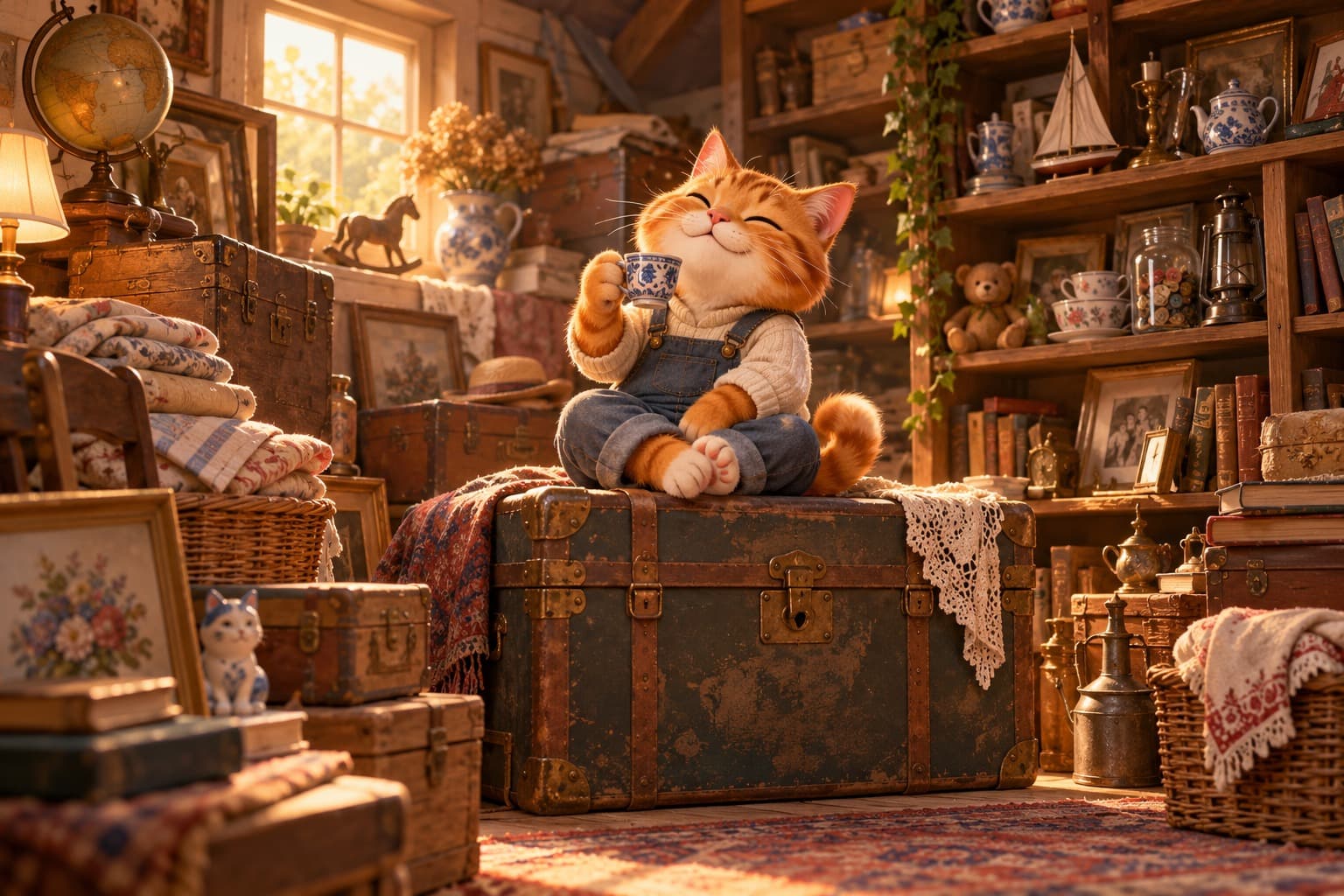
Two calls in the same week. Sometimes from the same family.
The first: can you take a sofa to the ecoponto. Nothing wrong with it. We just don't want it any more.
The second: can you move five boxes of ornaments across the city. Small things. Figurines, vases, artificial flowers. Please be careful with them.
For a long time I thought those two calls contradicted each other. They don't. They're the same system, seen from two ends — and once you notice the rule, you can't stop noticing it.
The room that isn't in the photographs
Underneath a lot of houses here there is a room that never appears in the estate agent's photographs.
Chests. Lamps. Bicycles. Hats. Umbrellas. Glasses and plates and a dinner service for twenty. Ladders. A lawnmower. Furniture, always furniture, and the heavier the better. Handbags and out-of-fashion shoes, stored inside other furniture. Boxes of tools. Paintings, stacked.
I have been in basements the size of a small supermarket.
And none of it is a mess. That's the part I did not expect.
The clothes are folded. Things are clean. Boxes have their lids on, furniture is stacked the way somebody stacks furniture when they intend to find it again. You don't come out dusty and irritated the way you do from a junk room. It's closer to being let into a private museum that happens to have no visitors and no labels.
Which is evidence in itself, if you think about it for a second. Nobody folds rubbish.
And the traffic down there follows the shape of a family. A son emigrates, and the furniture from his apartment goes down. He comes back years later, and the furniture from his house goes down too, because now there's a renovation. The family grows, shrinks, marries, separates, moves across town. Every one of those events sends something down the stairs.
Nobody ever says this is rubbish. What gets said is we'll see later.
They throw things out. Constantly.
Here's the part that took me a couple of years to notice.
They throw things out. Constantly. A good share of our work is runs to the ecoponto with perfectly decent sofas, tables, wardrobes, mattresses — furniture that would be sold second-hand anywhere else and is simply, cheerfully, finished with.
So it isn't that nothing can be let go. Something is being sorted, and the criterion is extremely precise.
A sofa in good condition goes.
Twelve pipes that belonged to a great-great-grandfather do not, and nobody in that house has smoked for fifty years.
It isn't storage. It's what gets handed on.
My reading — and it's a reading, not a fact about a country — is that those basements aren't storage.
They're where a family keeps what it means to hand on.
Not what might be useful later. What somebody, eventually, is supposed to receive. The pipes. The bottles of wine nobody is going to open. A recipe for bacalhau that only really works when one particular aunt makes it. The heavy furniture that three generations have eaten at. Symbols carved into things.
Which explains the sorting perfectly. The sofa is worth money and carries nothing. The five boxes of ornaments are worth nothing and carry everything. Charge by the cubic metre and you'd price it exactly backwards.
And people here laugh about it themselves. It comes up as a joke, affectionately, the way you'd talk about a national habit you have no intention of giving up. Nobody needs a foreigner to point it out — I'm just the one who ends up carrying it down the stairs.
It doesn't track with money, either, which is what surprised me most. I've seen it in a house with statues standing indoors, and in a one-bedroom flat where the whole inheritance fits in five boxes and moves with its owner every single time. Same instinct. Different square metres.
And then I looked at my own spare room
A table, still boxed, that I have never taken out. Surfboards I stopped using because there's no time. Boxes and boxes of tools. Paints for a hobby I no longer enjoy, because other hobbies replaced it. Objects I could not describe to you if you asked.
It is not a museum. Nothing in there is folded.
I arrived in this country with two suitcases.
If I had to move tomorrow, it would take a van. Possibly two. And a third for the vases and the plants.
I have no idea how that happened. I can't point to the moment. There was no decision — which, now that I write it down, is the entire point of the basements: nobody ever decides. Things simply stop leaving.
There's a word for it: arrumos
What I like about it is that it doesn't name a room. It names the things — and then, by extension, whatever space they took over. A spare room, an attic, a basement, a rented unit on an industrial estate that exists purely so that families can keep having basements after the basement is full. The place isn't specified. Only the purpose is.
My first house in Porto had an enormous basement. I remember standing in it and laughing. What does anybody need this much basement for.
I need one now. Badly.
So I've stopped thinking of any of this as a Portuguese habit, and started thinking of it as what happens to anybody who stays somewhere long enough to start keeping things for later.
Some people have a basement for it. Some people have five boxes. I have a spare room and a table I've never unpacked.
If any of this is about to become your problem — a basement that needs emptying, a run to the ecoponto, or five boxes that have to arrive in one piece — that's work we do, and we don't confuse the two.
We look after your things. But we also try to look after the moment you're going through.
Moving in Porto?
Tell us what you need moved — big or small, with kids or pets or one fragile thing. A free, no-pressure quote, from a team that treats your move as more than boxes.
Get a free quote on WhatsApp